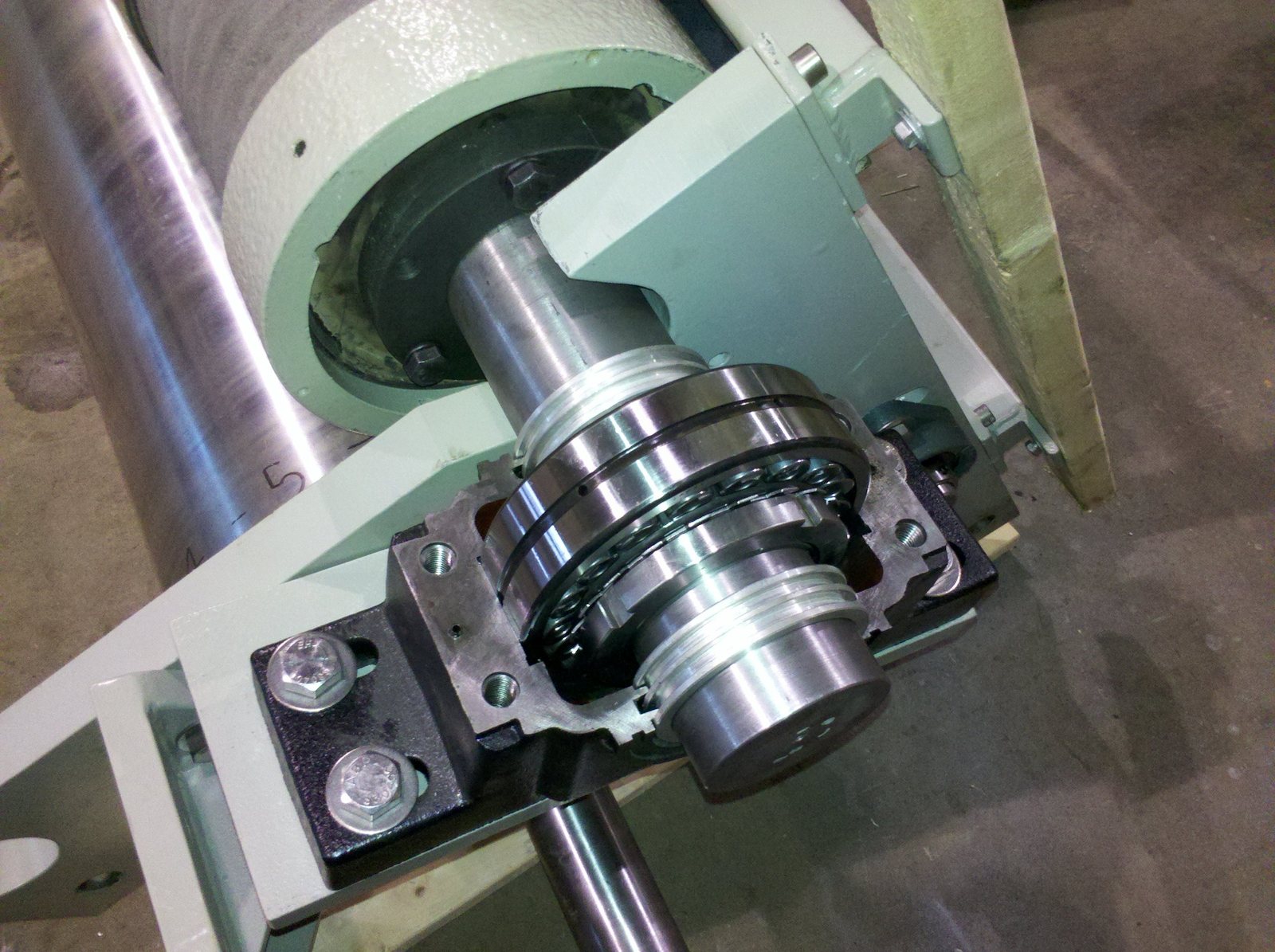


The tempting shortcut
What changed before the housing got hotter?
A bearing housing is hotter than it was on the last route. Before reaching for grease, check the recent history. Did the load increase? Did the cooling change? Was the bearing lubricated just before the reading? Each answer changes what you should inspect next.
A thermogram cannot answer those questions on its own. The camera detects infrared radiation from the housing surface and estimates surface temperature using settings for emissivity, reflected temperature, distance, atmosphere and any inspection window. It does not directly measure grease quantity, lubricant-film thickness or temperature at the rolling contacts.
Read the scale before the story
First decide whether the hot spot is real.
A thermal camera can be precise and still produce a poor comparison. With one set of camera parameters, a painted housing and a bare metal fitting can display different readings even when their actual surface temperatures are equal. Low-emissivity metal can also reflect the thermographer or nearby equipment. The palette is formatting, not proof. Always read the scale and the stored measurement.
Compare the same surface point with the same camera setup, view and emissivity method. Then compare the machine under the same speed, load, run time and cooling conditions. A bearing measured during warm-up is not a fair comparison with one measured after its temperature has settled.
Match the surface, camera, angle, distance, focus, range, emissivity basis and any inspection window.
Record actual speed, load, process condition, run time and recent starts, stops or lubrication.
Check ambient conditions, cooling airflow, nearby process heat and changes to guards or insulation.
Treat a difference as actionable only when it exceeds expected measurement uncertainty and route repeatability. A similar bearing can add context, but it is not an automatic control. Drive-end and non-drive-end bearings may carry different loads and receive heat through different paths. Site and equipment limits govern escalation. No single housing temperature can prescribe grease for every bearing arrangement.
One reading, several heat paths
A hot housing can sit on opposite lubrication problems.
Housing temperature settles where generated heat and dissipated heat balance. Bearing and seal friction generate heat. Load, speed and lubricant behaviour change that generation. The housing, surrounding air and foundation remove heat, while the shaft or process can conduct more heat into the arrangement. A higher reading says that this balance moved. It does not say which term moved.
A grease-lubricated bearing is not a container to fill to the brim. Too little lubricant can starve the contact. Too much can force rotating parts to churn through grease, raise drag and leave displaced grease with nowhere to go. Adding grease to an overfilled housing can make the temperature rise further.
Opposite problems can produce the same warning
- Too little reaching the contact
- Inadequate lubricant supply can leave the rolling contact starved. Verify delivery and lubricant suitability.
- Too much in the housing
- Churning and a restricted exit can increase drag and heat. Verify quantity and the purge path.
Quantity is only one branch. Wrong base-oil viscosity, an incompatible grease mixture, inadequate oil release, degraded grease or contamination can impair supply or film formation and may increase friction. Load, preload, clearance, fit, alignment, seal friction, bearing damage, restricted cooling and external process heat remain credible alternatives.
| Cause family | What may be happening | What to verify |
|---|---|---|
| Lubricant quantity | Inadequate supply, excess grease or a blocked purge path | Specified quantity, interval, housing fill, metered output and exit path |
| Lubricant suitability | Wrong product, incompatible mixture, degraded grease or contamination | Product specification, compatibility, storage, handling and operating range |
| Mechanical condition | Load, preload, clearance, fit, alignment, seal friction or bearing damage | Vibration, alignment, mounting history, load, speed and seal condition |
| Thermal environment | Process heat, restricted cooling or changed surrounding conditions | Process temperature, airflow, guards, insulation and nearby heat sources |
Follow the lubricant
A completed pump cycle does not confirm delivery.
This check applies only to arrangements designed for relubrication. Sealed or lubricated-for-life units may not accept additional grease, so follow the bearing and equipment manufacturer's instructions before touching the system.
An automatic lubricator can complete its programmed cycle while the bearing receives the wrong quantity or nothing useful at all. The pump may run while a cartridge is empty, a metering device sticks, a line contains air, a passage is blocked or displaced grease has no clear exit.
A controller log proves only what its installed sensors observed. A command or completed pump cycle does not confirm point-level delivery unless the system measures it there. It is worth checking exactly where the system measures pressure or flow before relying on its log.
Pump pressure and delivered flow are different measurements. Grease leaving a pump or reaching an inlet fitting does not prove that the intended bearing passages and purge route are open. Verify the specified product, documented set point, actual metered output and downstream route under the site procedure.
Ask a question each method can answer
Choose the observation that can eliminate a cause.
Do not ask for another alarm. Ask for the measurement that can separate the remaining explanations. If load increased, the new temperature may belong to a new operating state. If temperature and repeatable ultrasound rise after lubrication while load remains steady, inspect quantity and purge conditions. If vibration also develops a repeatable local pattern, the mechanical condition deserves more attention.
- Operating stateShows whether speed, load, cooling or process heat changed with the temperature. It does not clear the bearing.
- Repeatable ultrasoundShows a change in high-frequency activity at the same point under the same setup. It cannot identify grease quantity by itself.
- Vibration analysisCan add a local dynamic pattern or contradiction. A stable trend does not prove the bearing is sound.
- Delivery verificationCan show expected output at the metering point and an open downstream route. It does not prove grease distribution at the rolling contacts.
These observations are not votes. Each has a different physical scope and a different job in the decision.
Illustrative fan-motor review
Repeated heating after a cycle changes the first inspection.
On a fictional process fan, the motor drive-end housing runs warmer than its own baseline. The technician used the same painted point, camera setup, load range and run time. The difference exceeds expected measurement uncertainty and route repeatability, so the change is worth investigating.
The timing matters. Temperature and high-frequency activity rose after the last two automatic lubrication cycles, then eased. Matched vibration shows no new repeatable local pattern. Speed, motor load and nearby process temperature remain within the route comparison. The controller records both cycles as complete, but it has no point-level flow measurement and nobody has recently checked the metered output or exit path.
That record does not clear the bearing. It does make another shot of grease a poor first move. Repeated heating after a cycle raises excess delivery and restricted purge as testable hypotheses. A metering or line fault still remains possible until the route is checked.
Use in the field
Hot-bearing verification checklist.
- Protect people and the machine.Follow site and equipment limits. Do not open guards, loosen fittings or disturb pressurized lines around operating equipment.
- Confirm the thermal change.Match the surface, emissivity basis, reflected temperature, camera setup and route, then check that the difference exceeds measurement uncertainty.
- Match the operating state.Compare actual speed, load, process condition, run time, ambient state, cooling and recent starts or stops.
- Put events on one timeline.Place lubrication cycles, product changes, maintenance and load changes beside the thermal trend.
- Trace the delivery route.For a relubricable arrangement, check the specified grease, reservoir, pump, metering point, line, housing passage and exit path.
- Choose one separating check.Use matched thermography, ultrasound, vibration, operating data or a controlled delivery test to eliminate a cause.
Technical sources
Primary references behind the field method.
These references inform the measurement and reasoning principles in this field note. They do not imply ConditionCore certification or conformity with a particular standard.
- ISO 18434-1:2008General thermography procedures, interpretation, reporting and measurement controls.
- FLIR temperature measurement parametersHow emissivity, reflected temperature, distance, atmosphere and inspection windows affect a calculated surface temperature.
- Fluke industrial thermography application guidePractical guidance on baselines, normal load and comparisons between similar bearings under similar conditions.
- SKF Rolling bearings catalogueBearing heat balance, operating temperature, load, speed, lubrication, friction and external heat sources.
- SKF Bearing Installation and Maintenance GuideGrease quantity, churning, relubrication and the need for fresh grease to reach the bearing and displaced grease to exit.
- NSK operation inspection guidanceHow housing surface temperature relates to bearing temperature, the move toward steady state and possible causes of abnormal temperature.
- SKF automatic lubrication pump manualA product-specific example showing that a running pump may still fail to deliver because of an air pocket, empty cartridge or downstream blockage.
- ISO 29821:2026Ultrasound procedures, error sources, repeatability and interpretation of high-frequency activity associated with friction, impact and improper lubrication.
- ISO 13373-1:2002Vibration measurement, point selection, operating conditions and data collection.
- ISO 13373-3:2015Structured vibration diagnosis and the limits of a single observation.
Back at the machine
Let the temperature choose the investigation, not the grease quantity.
Record what changed, what remains uncertain and which check will narrow the cause. A useful work order asks for a matched thermal reading, a delivery check or an inspection of the purge path. It does not prescribe extra grease from temperature alone.
Review a machine with ConditionCore