
Before the work order changes
Verify the comparison before reserving the bearing.
The route report marks a drive-end point red. Vibration is higher than last month, and the shutdown planner wants to know whether to reserve a bearing. This is the moment a measurement can harden into a diagnosis too early. Before the work scope changes, the team needs five answers: where was it measured, when, under what operating state, how, and against which baseline?
Higher vibration can result from operating state, transmission path, sensor attachment or developing mechanical distress. Record the observation and its context before assigning a cause.
Five questions before a fault name
Qualify the comparison before you explain the change.
A trend is only as useful as the comparison behind it. Point, attachment, acquisition method and operating state must be recorded with each value. A correctly collected reading can still be the wrong comparison.
Asset, component, exact point, axis or image region.
Timestamp, sequence, sample age and relation to other evidence.
Speed, load, process condition, warm-up and recent intervention.
Sensor, mounting, instrument, gain, filter, emissivity, sample point and laboratory method.
A matched baseline, repeated route, peer asset or justified limit.
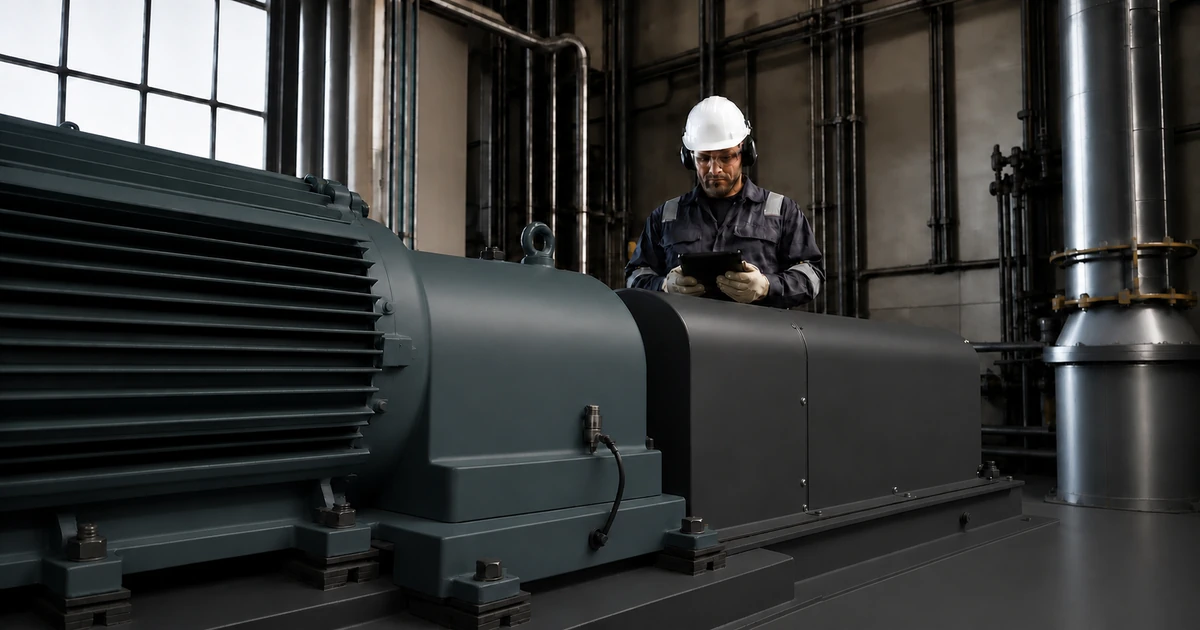
A trend point without context is like a photograph with its date and location removed: it may be genuine, but it is weak evidence of change. The photograph does not diagnose the machine. It explains why provenance matters.
When another observation enters the review
More evidence helps only when each method keeps its limits.
For each added observation, state what it can localize, what it cannot and whether it describes the same machine state. Vibration may narrow the location, subject to structural transmission and checks at adjacent points. Thermography observes apparent surface temperature. Ultrasound depends on a controlled, repeatable setup. A simple current trend mainly reflects operating demand. A properly acquired electrical signature from a three-phase induction motor can test motor, supply and torque-load hypotheses, but it rarely locates one gearbox component by itself. Routine bulk-oil results describe the sampled compartment; in a shared sump, concentration trend alone usually cannot identify the source. Particle size, shape, composition, machine metallurgy, filtration state and sample location can narrow a likely wear mechanism or source region. They rarely prove one component without inspection.
Contradictory evidence may weaken the leading explanation, reveal a timing mismatch or identify the next measurement that could change the work order.
Illustrative field method
Does the trend justify changing the shutdown scope?
Consider a fictional variable-speed process fan. Its motor drive-end vibration trend rises before a planned outage. The decision is whether the current evidence justifies adding a bearing replacement to the work scope.
The drive-end enveloped-acceleration level and spectrum are higher than last month, but speed, load, sensor mounting and envelope-processing settings differ. The records are not yet directly comparable.
The team verifies the point, axis, attachment and bearing identity, then records actual shaft speed rather than relying on the drive command.
With the installed bearing identified and shaft speed measured, matched enveloped spectra show repeatable energy at the calculated ball-pass frequency outer race, or BPFO, and related harmonics. That pattern is consistent with impacts repeating at the outer-race pass rate, but it does not by itself prove an outer-race defect.
An adjacent point does not show the same pattern. The surface-temperature pattern does not corroborate the vibration concern at that location and time, but it does not rule out early or internally localized distress.
A production-rate change and recent fan work could alter aerodynamic excitation or transmission. Developing bearing distress and an operating-state effect both remain plausible.
Use in the field
Five questions before the work order changes.
- What changed?Record the measurement, pattern, point, units and timestamp without naming a cause.
- Can it be compared?Check point, setup, speed, load, process state, sample age and recent maintenance.
- What can it localize?Preserve component, drive-train and sampled-compartment evidence as different scopes.
- What else fits?State the leading hypothesis, one credible alternative, supporting evidence and contradiction.
- What changes the decision?Choose the safest repeat measurement or inspection that can alter the action window.
Technical sources
Primary references behind the field method.
These references inform the measurement and reasoning principles in this field note. They do not imply ConditionCore certification or conformity with a particular standard.
- ISO 17359:2018General guidelines for machine condition-monitoring programmes.
- ISO 13373-1:2002Vibration measurement, collection, location, attachment and operating-condition guidance.
- ISO 13373-3:2015Structured guidance for vibration diagnosis of rotating machines.
- SKF Spectrum AnalysisPractical interpretation of rotating-machine spectra, including calculated bearing frequencies and harmonics.
- ISO 18434-1:2008Thermography procedures, including emissivity and reflected-temperature considerations.
- ISO 29821:2026Airborne and structure-borne ultrasound procedures, error sources and interpretation.
- ISO 20958:2013Online electrical signature analysis of three-phase induction motors.
- ISO 13379-1:2025General procedures for data interpretation and diagnostic approaches.
- ISO 14830-1:2019Tribology-based monitoring requirements and guidance for machine systems.
Back at the planning table
Retain the alarm as evidence without treating it as a diagnosis.
A verified comparison, credible alternatives and a testable next check allow the alarm to support a defensible maintenance decision.
When the alarm survives that first review, bring it into the integrated machine review without turning the added methods into confirming votes.
Review a machine with ConditionCore