Unbalance
Running-speed behaviour assessed against direction, location and operating state.
Vibration analysis
The ConditionCore workflow is designed to accept time waveforms, spectra, enveloped data and trends, retain speed, load and measurement-point context, and test vibration patterns against the rest of the machine evidence.
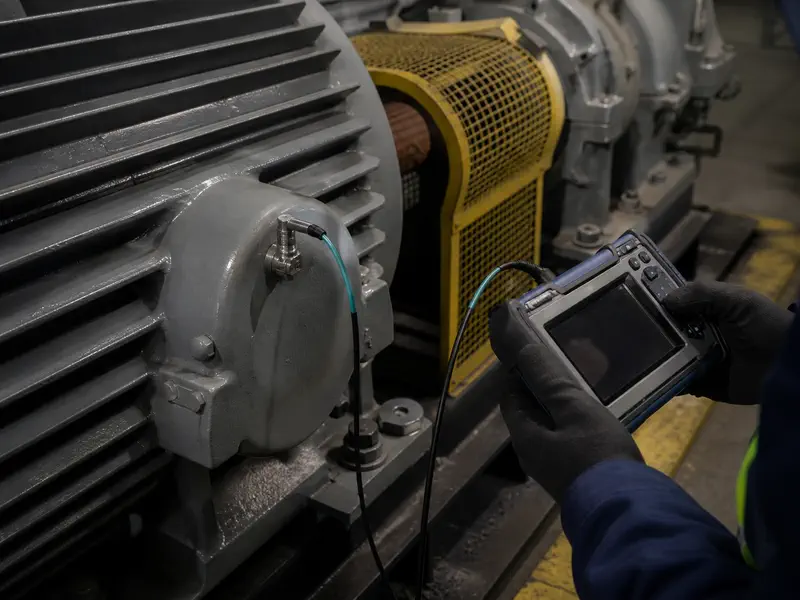
Vibration analysis
Keep the point, axis, acquisition setup, speed and load attached to every waveform and spectrum.
Illustrative signal path
Illustrative · not a customer resultA raw trace becomes useful evidence only after the acquisition setup, machine speed and component location travel with it.
GBX-2 input-bearing housing
Configured ball-pass frequency, outer race (BPFO), and harmonics
Possible developing outer-race distress
Confirm setup; corroborate with other evidence
The displayed family is based on a configured bearing geometry. A spectral match alone does not establish fault severity or root cause.
Data in
Vibration patterns generate hypotheses. Confidence depends on acquisition quality, machine configuration and operating context.
What it can reveal
Running-speed behaviour assessed against direction, location and operating state.
Axial and radial patterns considered with coupling geometry, load and temperature.
Harmonic and impact behaviour tested against mounting and structural transfer.
Amplitude and phase change assessed across speed and structural response.
Configured bearing-frequency families, including ball-pass frequency, outer race (BPFO), and modulation tracked at the measurement point.
Mesh families, sidebands and load-dependent change related to the gearbox stage.
How ConditionCore uses it
Unbalance, misalignment, looseness, bearing and gear-mesh patterns, kept tied to speed, load and measurement point.
Preserve the raw data, acquisition setup, machine speed and measurement point.
Build a like-for-like reference using matched operating conditions.
Relate changing frequency families to the component and measurement location.
Test the leading mechanical hypothesis against thermal, ultrasonic and oil evidence.
Common questions
See the controls required for a trustworthy comparison.
Vibration analysis can reveal patterns associated with unbalance, misalignment, looseness, resonance, rolling-element bearing defects and gear-mesh faults. Interpretation still depends on the machine, point location and operating state.
Yes. Time waveforms, FFT spectra, enveloped or demodulated spectra, orders, overall values and trends can be retained with their acquisition and asset metadata.
Sometimes vibration strongly localizes a hypothesis, but one channel rarely resolves every competing explanation. ConditionCore shows what vibration supports and what still requires corroboration.
First machine review
Share one changing asset and the files you already have. We will confirm what is usable, what remains uncertain and which next check is most valuable.
Request a machine review